The Registry 20 Years Later
Three-day convening on public conviction registries
November 18–20, 2016
Description
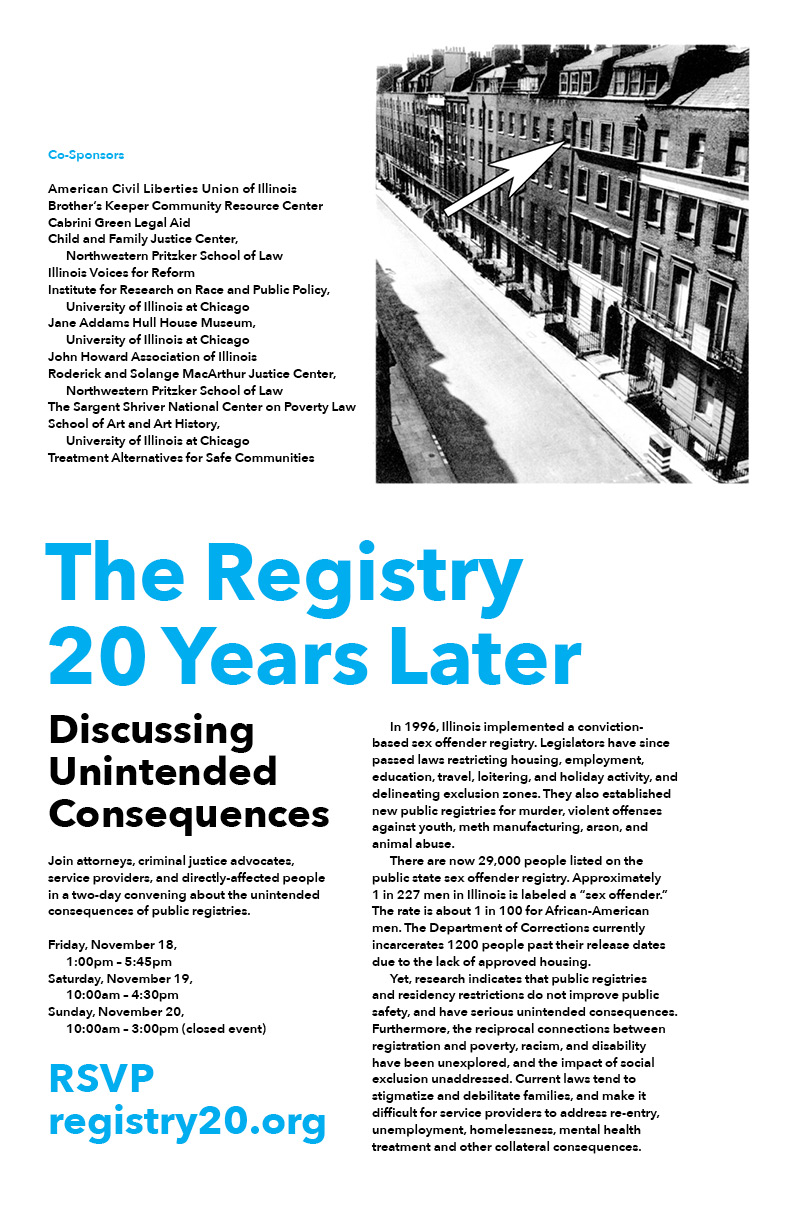
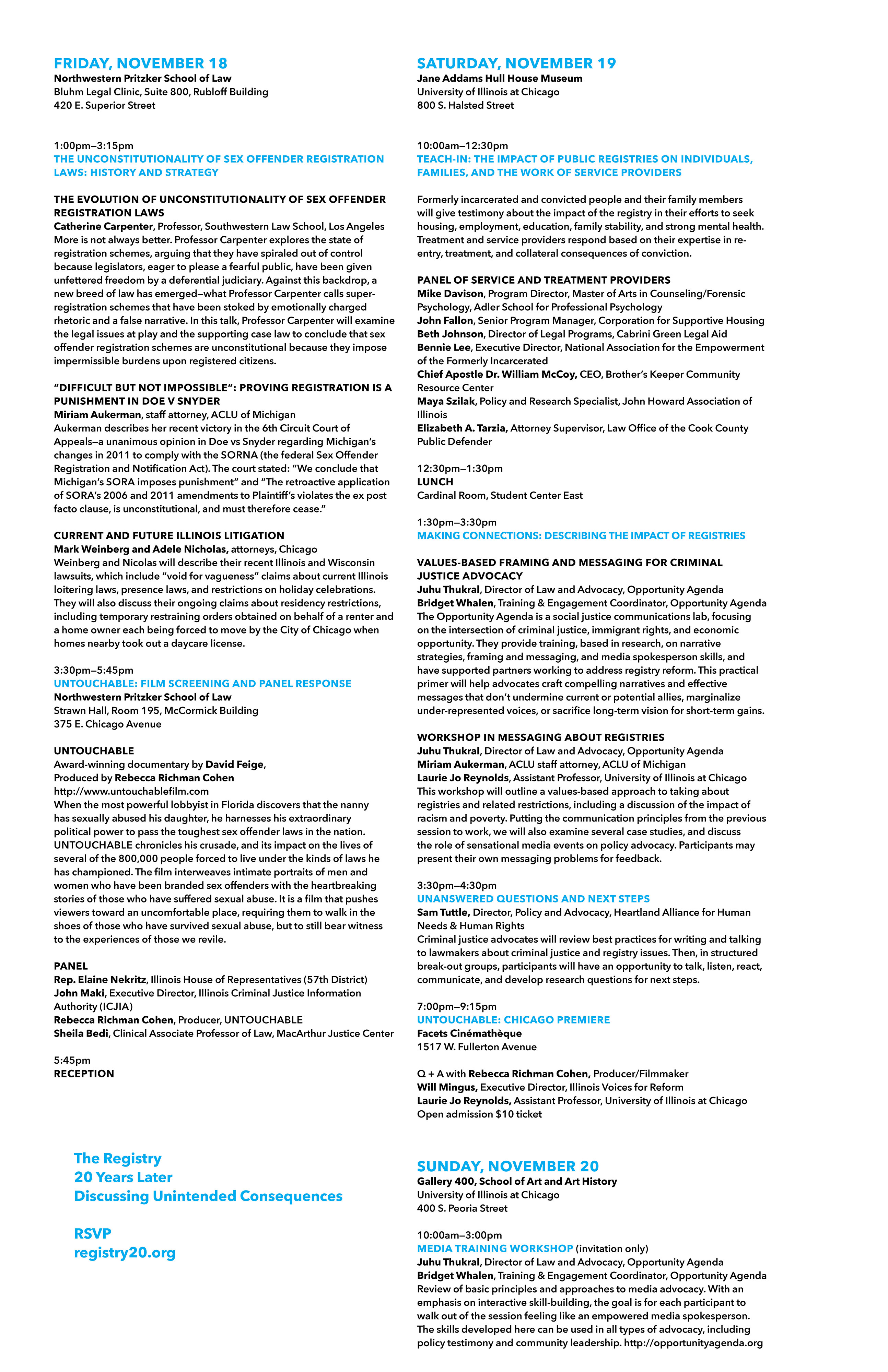
This was the first conference in the country to include all public conviction registries, and also to bring people on registries directly in dialogue with policymakers, state officials, justice advocates and service providers. The convening took place over 3 days at Northwestern University Pritzker School of Law, Jane Addams Hull-House Museum at University of Illinois at Chicago, and Facets Multimedia.
Credits
Organized by Laurie Jo Reynolds, University of Illinois at Chicago, with advocates and activists including Will Mingus, Scott McFarland, Sam Tuttle, Juhu Thukral, Stephanie Kollman, Eraena Hart, Locke Bowman, Jennifer Scott, and Ross Jordan.
Program
Link to program for The Registry 20 Years Later: Discussing Unintended Consequences.
Conference rationale
In 1996, Illinois implemented a conviction-based registry for people with past sex offense convictions. Legislators have since passed laws restricting housing, employment, education, travel, loitering, and holiday activity, and delineating exclusion zones. They also established new public conviction registries for murder, violent offenses against youth, meth manufacturing, arson, and animal abuse.
There are now 29,000 people listed on the public state sex offense registry. Approximately 1 in 227 men in Illinois is labeled a ''sex offender." The rate is about 1 in 100 for African-American men. The Department of Corrections currently incarcerates 1200 people past their release dates due to the lack of approved housing.
Yet, research indicates that public registries and housing banishment laws do not improve public safety, and have serious unintended consequences. Furthermore, the reciprocal connections between registration and poverty, racism, and disability have been unexplored, and the impact of social exclusion unaddressed. Current laws tend to stigmatize and debilitate families, and make it difficult for service providers to address re-entry, unemployment, homelessness, mental health treatment, and other collateral consequences.
Join attorneys, criminal justice advocates, service providers, elected officials, and directly-affected people in a convening about the unintended consequences of public registries.
Co-sponsors
American Civil Liberties Union of Illinois
Brother’s Keeper Community Resource Center
Cabrini Green Legal Aid
Child and Family Justice Center,
Northwestern Pritzker School of Law
Illinois Voices for Reform
Institute for Research on Race and Public Policy,
University of Illinois at Chicago
Jane Addams Hull House Museum, University of Illinois at Chicago
John Howard Association of Illinois
Roderick and Solange MacArthur Justice Center, Northwestern Pritzker School of Law
The Sargent Shriver National Center on Poverty Law
School of Art and Art History, University of Illinois at Chicago
Treatment Alternatives for Safe Communities